
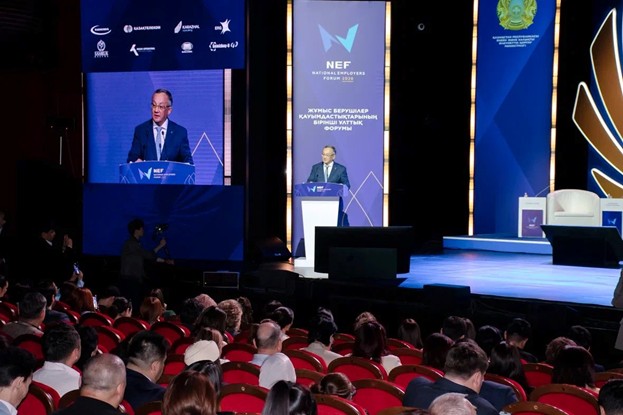
On Monday, May 18, Chairman of the Federation of Trade Unions of the Republic of Kazakhstan (FTURK) Satybaldy Dauletalin took part in the First National Forum of the Employers’ Association NEF 2026, organized by the “PARYZ” Confederation of Employers. During the forum, representatives of government bodies, trade union communities, employers’ associations and international experts discussed issues related to strengthening social partnership amid labour market transformation, as well as the development of working professions, modernization of the vocational education system, occupational safety and enhancement of business social responsibility.
Addressing the forum participants, Deputy Prime Minister of the Republic of Kazakhstan and Minister of Artificial Intelligence and Digital Development Zhaslan Madiyev noted that in the era of rapid labour market transformation, social partners face common challenges.
“Society needs to solve several key tasks – to find answers to the challenges of digitalization, ensure lifelong learning and modern methods of worker protection,” emphasized Zhaslan Madiyev.
Chairman of the Federation of Trade Unions of the Republic of Kazakhstan Satybaldy Dauletalin also delivered a welcoming speech to the forum delegates. In his address, the FTURK Chairman stressed that holding the first employers’ forum represents an important milestone in the development of social dialogue and the strengthening of the institution of responsible business in Kazakhstan.
“Holding such a forum is truly an important and symbolic event for our country. It demonstrates that business in Kazakhstan is reaching a new level of maturity, when the entrepreneurial community is ready not only to solve economic issues, but also to participate in discussing key social matters that directly affect the sustainability of the state and society,” noted Satybaldy Dauletalin.
The Kazakh trade union leader highlighted the main challenges facing the changing labour market.
“Today we all see how rapidly the labour market is changing. Digitalization, automation, the introduction of new technologies and the development of artificial intelligence are fundamentally transforming production, labour organization and the requirements for specialists. Kazakhstan is already facing these challenges to the fullest extent. Under these conditions, the sustainability of the state is determined not only by economic indicators, but also by the ability of all parties – the state, business and workers – to hear one another, jointly seek solutions and build a long-term system of interaction,” said the Chairman of the Federation of Trade Unions.
According to him, the modern employer is becoming one of the key actors in shaping a sustainable socio-economic policy.
“Today, the role of the employer goes far beyond purely production-related tasks. The employer of the 21st century is no longer just an owner or manager. It is a participant in the shared responsibility for the development of the economy, labour market and society as a whole. Today, this hall has gathered people whose decisions directly affect the labour market situation, the level of social stability and attitudes toward working people in our country. However, the key issue today is no longer only about technologies. The main question is where to find qualified personnel, how to retain specialists, how to ensure generational continuity in production and how to maintain a balance between economic efficiency and social sustainability. This issue is becoming decisive for the development of Kazakhstan’s industry and economy,” emphasized the FTURK Chairman.
Satybaldy Dauletalin stressed that the shortage of personnel is being felt particularly acutely in the country’s industrial regions.
“During our meetings with labour collectives in the regions, especially in industrial areas, this issue is raised at almost every meeting. Employers and workers themselves increasingly say that it is becoming more difficult to find qualified specialists and representatives of working professions for new projects and modern production facilities. Many enterprises are already forced to increase the workload on existing teams, postpone expansion plans and independently retrain young specialists directly at enterprises. This is already a serious signal for the country’s economy,” noted the Chairman of the Federation of Trade Unions of Kazakhstan.
Satybaldy Dauletalin emphasized that under current conditions, investment in human capital and the quality of labour relations is becoming increasingly important.
“Today, it is no longer enough simply to create jobs. People want to see decent working conditions, respect for their profession, fair wages and opportunities for professional growth. It is impossible to effectively develop industry, launch new production facilities and ensure technological modernization amid a shortage of qualified personnel. This is why investments in workers’ qualifications, modern technologies and the quality of labour relations are becoming increasingly important. This directly determines whether young people will connect their future with manufacturing, industry and working professions. We need to create conditions under which working people will see prospects, stability and respect for their professional choice,” noted Satybaldy Dauletalin.
According to him, it is critically important today to build a modern personnel training system in which colleges, universities, enterprises and employers work jointly in line with the real needs of the economy.
“No less important is the issue of retraining workers in the context of digitalization and the introduction of artificial intelligence. We understand that many professions will transform, while some specialties will require entirely new competencies. Therefore, the state, business and trade unions must jointly help people adapt to the new economy and ensure opportunities for continuous learning and professional development,” said Satybaldy Dauletalin.
The FTURK Chairman paid special attention to occupational safety issues and the development of a new culture of labour relations.
“Occupational safety must remain an unconditional priority. No production efficiency or economic indicators can be above the life and health of workers. This principle must form the basis of every enterprise’s activities. Equally important is a new culture of labour relations – without confrontation and without attempts to oppose business and workers. A protected worker and a strong employer are the two foundations of sustainable economic development. Only by maintaining a balance of interests can long-term stability and development be ensured,” stressed Satybaldy Dauletalin.
The Chairman of the Federation of Trade Unions also noted the importance of the socio-economic reforms being carried out in the country.
“Today, at the initiative of the President of the country, large-scale reforms aimed at modernizing the economy, developing working professions, digitalization and strengthening the principles of a Just Kazakhstan are being implemented. The new constitutional model has placed the working person, justice, legality and social responsibility at the center of attention. Today, it is extremely important that the principles of a Just Kazakhstan are reflected not only in documents and strategies, but also in the daily practices of enterprises, companies and organizations. This is why the country needs a new level of social partnership based on genuine trust, shared responsibility and readiness to jointly make decisions on issues that determine the future of the labour market,” emphasized Satybaldy Dauletalin.
According to the Chairman of the Federation of Trade Unions of the Republic of Kazakhstan, state support should be provided to enterprises investing in employee development and occupational safety.
“It is necessary to support socially responsible business. Enterprises that invest in wages, occupational safety, employee training and modernization of production should receive real measures of state support. This is the most important condition for building a sustainable economy and increasing the attractiveness of working professions,” stressed Satybaldy Dauletalin.
The FTURK Chairman emphasized that Kazakhstan has every opportunity to become one of the leading industrial and technological centers of Central Asia.
“Kazakhstan truly has the opportunity to become a strong industrial and technological center of the region. But to achieve this, we must win the main competition – the competition for people. The most important question today is whether together we can create a labour market where people see prospects, respect for their work and confidence in the future. Whether young people choose manufacturing, working professions and connect their future with Kazakhstan depends on the decisions being made today. The future of the country is shaped not only at the level of state decisions. It is determined at every enterprise, in every labour collective and in the attitude toward working people. If we learn to maintain a balance of interests between business, the state and workers, Kazakhstan will be able to become one of the most sustainable and competitive countries in the region,” summarized Satybaldy Dauletalin.
In turn, International Labour Organization Coordinator for Employers’ Activities in Europe Henrik Moller noted that sustainable labour market development and the effective functioning of employers’ organizations directly depend on their ability to build systematic work with social partners.
“Another important area remains the development of constructive dialogue between employers, the state and trade unions. It is precisely this format of cooperation that allows balanced solutions to be developed, ensures labour market sustainability and enables effective responses to modern economic and technological challenges,” said the international expert.
Chairman of the Presidium of the National Confederation of Employers “PARYZ” Zhumabek Zhanykulov noted that the main task of the confederation is to strengthen dialogue between business, the state and trade unions.
“Today, more than 300 employers’ associations operate in Kazakhstan, and all of them are created by people who sincerely want to benefit the country, their industry and business. Our task is to unite them, strengthen dialogue, increase trust and jointly seek solutions. In the modern world, investments, technologies and factories are impossible without people, which is why the development of competencies, education and the ability to adapt quickly to change are becoming key conditions for economic competitiveness,” emphasized Zhumabek Zhanykulov.
The forum continued with a panel session during which the position of the state was presented by Minister of Labour and Social Protection of the Population of the Republic of Kazakhstan Askarbek Yertayev.
“The transformation of the labour market requires joint work by the state, trade unions, employers, educational institutions and digital platforms. We invite all participants of today’s forum to partnership in the development of professional standards, personnel training, the development of digital employment and the formation of a new labour culture in Kazakhstan. Our common task is to build a labour market that is not only flexible and technological, but also fair, safe and people-oriented,” noted the head of the Ministry of Labour and Social Protection of the Population of Kazakhstan.
In his speech, Minister of Science and Higher Education of the Republic of Kazakhstan Sayasat Nurbek emphasized that education systems and labour market regulation worldwide are failing to adapt quickly enough to the rapid changes associated with the development of artificial intelligence and digital technologies. According to him, Kazakhstan is already moving toward a new model of personnel training based on lifelong learning, rapid adaptation and the development of future skills.
“We are coming to understand that the education system must teach people the key skill of the future – the ability to adapt quickly, retrain and work in conditions of constant change,” noted Sayasat Nurbek.
The Minister reported that Kazakhstan has already developed 20 regional Atlases of New Professions and a digital labour market analysis system covering more than 73,000 enterprises. In addition, in 2025 artificial intelligence became a mandatory discipline for all university students in the country.
The role of social partnership in achieving the Sustainable Development Goals was highlighted in the speech of the UN Resident Coordinator in Kazakhstan, Sarangoo Radnaaragchaa.
“Sustainable development is impossible without decent work, and decent work means not only employment, but also safety, equal opportunities, respect for human dignity and social justice. Partnership between the state, employers and workers, as well as investments in future skills, lifelong learning and the development of an inclusive economy, are becoming particularly important. It is precisely this approach that will ensure business sustainability, economic competitiveness and the ability of every person to adapt to new labour market conditions,” emphasized the UN Resident Coordinator in Kazakhstan.
Chairman of the National Chamber of Entrepreneurs of the Republic of Kazakhstan “Atameken” Kanat Sharlapayev, Chairman of the “KAZENERGY” Association Bolat Akchulakov, Chairman of the Management Board of JSC “Kazakhtelecom” Bagdat Musin, Chief Specialist of the Technical Support Group on Decent Work and the ILO Office for Eastern Europe and Central Asia Vladimir Churovich, and other participants also shared their vision for the further development of the employers’ community and its role in shaping the labour market under modern conditions.
FTURK Trade Union Communications Center