
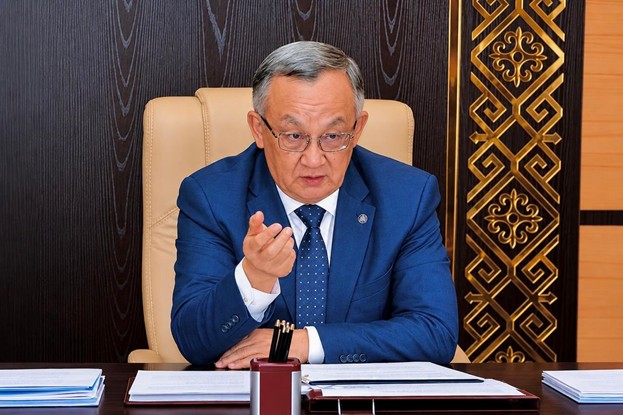
On Friday, May 22, a meeting of the Executive Committee of the Federation of Trade Unions of the Republic of Kazakhstan (FTURK) was held under the chairmanship of FTURK Chairman Satybaldy Dauletalin.
During the meeting, Executive Committee members reviewed information presented by the territorial trade union associations of Pavlodar and Akmola regions regarding the work of regional tripartite commissions, as well as practical examples of implementing agreements in the field of social partnership.
Chairman of the Territorial Association of Trade Unions “Trade Union Center of Akmola Region” Kali Rakhmetov delivered a report on the activities of the Akmola Regional Tripartite Commission.
He noted that social partnership in the region serves as a key mechanism for regulating labour relations.
The region currently operates under a regional agreement for 2024–2026, as well as similar agreements in 17 districts and 3 cities. Last year, 17 meetings of the regional commission were held, during which 47 issues were reviewed.
“It is important to emphasize that 28 percent of all issues considered were initiated by the trade union side. This demonstrates that trade unions are not merely participating in the commission’s work, but are shaping its agenda,” noted the Chairman of the Trade Union Center.
According to him, 536 commission meetings were held in districts and cities, during which 1,072 issues were considered.
“The results of our work should not be measured by the number of meetings, but by the changes achieved for workers. And such changes do exist. At the municipal enterprise ‘Kokshetau Zhylu,’ additional social guarantees were included in the collective agreement, including financial assistance during annual leave, retirement compensation and support for workers facing difficult life circumstances. At ‘Kokshetau Energo,’ wages for certain categories of employees increased two to three times. At a number of enterprises, wage growth ranged from 10 to 50 percent. This is the result of negotiations and social partnership efforts,” emphasized the Chairman of the Territorial Association.
After reviewing the situation in Akmola Region, Chairman of the Federation of Trade Unions of the Republic of Kazakhstan Satybaldy Dauletalin outlined specific tasks related to protecting workers’ rights and ensuring occupational safety.
The FTURK Chairman called for eliminating a formal approach to monitoring labour agreements and instructed that approaches to occupational injuries be reconsidered.
“Cases of occupational injuries, including severe and fatal incidents, continue to be recorded in the country. At the same time, the level of injuries is lower at enterprises where trade unions are present. We see a direct correlation: where trade unions are genuinely integrated into the occupational safety management system, where production councils and technical inspectors are active, the level of risk is significantly lower. This confirms the effectiveness of public oversight. According to the directives established by the FTURK General Council, for every fatal workplace incident, a joint Roadmap with the employer must immediately be developed to fully eliminate the risks and causes of the tragedy. Approximately 200 people die annually in workplace incidents across the country. We declare our commitment to the concept of ‘zero injuries,’ but this requires daily work. Every meeting of a regional tripartite commission must begin exclusively with the key issue — occupational safety. This is priority number one,” emphasized Satybaldy Dauletalin.
The Chairman of the Federation of Trade Unions also highlighted the need to strengthen cooperation between the central office and regional Trade Union Centers during field visits and outreach activities.
Speaking about workers’ welfare, the FTURK Chairman initiated a detailed analysis of all existing collective agreements across regions.
Satybaldy Dauletalin pointed out the inadmissibility of the absence of clear statistics regarding wage indexation on the part of territorial trade union associations.
“Many people confuse wage indexation with wage increases, hiding behind loud populist slogans. In reality, indexation means preserving workers’ purchasing power and maintaining the standard of living they had the previous year. This work must be carried out every day. According to our analysis, currently only 10 percent of collective agreements nationwide legally include a clause on wage indexation. These issues must also be raised during meetings of regional tripartite commissions,” stressed the FTURK Chairman.
At the same time, Satybaldy Dauletalin announced a new step within the framework of digital transformation — the creation of a National Register of Collective Agreements. Local trade union leaders were instructed to use direct communication channels with primary trade union organization chairpersons in order to form an objective picture and identify those obstructing the implementation of protective mechanisms.
In addition, the Chairman of the Federation of Trade Unions of Kazakhstan addressed issues of interaction within the tripartite dialogue “trade union – state – employer.” It was noted that the recent first National Employers’ Forum demonstrated the business community’s willingness to care about working people. However, effective negotiations in the regions require consolidated, legitimate and strong partners represented by профильные associations and confederations.
Further information on the work of the Pavlodar Regional Tripartite Commission was presented by Dinara Aitzhanova, Chairwoman of the Territorial Association of Trade Unions “Trade Union Center of Pavlodar Region.”
According to her, social partnership in the region is a daily mechanism for regulating labour relations.
Regarding employment and incomes, she reported that the unemployment rate stands at 4.9 percent, while enterprises continue to face a shortage of qualified specialists.
“The average monthly wage is around 449,000 tenge, but inflationary pressure is reducing the real purchasing power of incomes.
We are observing a situation where nominal wage growth is not always felt by workers. The real value of incomes is decreasing due to inflation. Therefore, issues of indexation and protection of real wages are now becoming central to social dialogue,” noted Dinara Aitzhanova.
The Chairwoman of the Trade Union Center also informed participants about occupational safety issues.
“It is fundamentally important that a tripartite agreement is not merely a declaration of intent. It is a direct-action document that must function at the enterprise level through collective agreements. We insisted that in an industrial region, occupational safety issues cannot remain part of general wording. They must be separated into a distinct section with specific obligations for the parties. As a result, we succeeded in securing a separate section dedicated to occupational safety,” she stated.
Within this section, obligations related to the development of production councils, support for technical inspectors and strengthening injury prevention measures were закреплены.
According to her, 881 production councils are currently operating in Pavlodar Region, and 1,240 technical occupational safety inspectors have been elected. The Trade Union Center succeeded in ensuring that the work of technical inspectors at several enterprises is financially supported. For example, at “Bogatyr Komir” LLP, payments of no less than 5 monthly calculation indices (MCI) have been introduced, while at Ekibastuz GRES-1 and Pavlodar Petrochemical Plant, payments of up to 10 MCI are provided for active work in identifying violations.
After hearing the report on the situation in Pavlodar Region, Chairman of the Federation of Trade Unions of the Republic of Kazakhstan Satybaldy Dauletalin paid special attention to mechanisms for increasing wages at public utility and life-support facilities. He emphasized that any changes in state tariff policy must directly affect the welfare of ordinary workers.
The Executive Committee meeting continued with consideration of the issue of holding the Republican Media Competition “Enbek Adamyn Ulyktau.”
Deputy Chairman of the Federation of Trade Unions of Kazakhstan Nurlan Uteshev presented a report on this issue.
He emphasized that organizing the media competition forms part of the systematic implementation of the FTURK Activity Strategy for 2025–2030 “Fair Labour in an Era of Change: Protection, Development, Innovation,” aimed at increasing the openness of the trade union movement and strengthening its position in the public and information space.
“The implementation of the Federation’s strategic objectives for 2025–2030 requires a qualitative strengthening of communication policy, expansion of presence in the media space and the formation of a modern image of trade unions that is understandable to society. Under these conditions, the ‘Enbek Adamyn Ulyktau’ media competition is viewed as a tool for institutionally strengthening trust in trade unions and increasing the social significance of labour,” noted Nurlan Uteshev.
During the discussion, it was emphasized that the media competition is of special importance in the context of increasing the Federation’s transparency.
“Throughout the Year of Working Professions, work has been carried out to popularize labour and elevate the status of working people. However, for the Federation of Trade Unions and for trade unions in general, every year is the Year of Working Professions. Naturally, we have never stopped this work, we have been doing it for 120 years and will continue to do so. One manifestation of this is raising the status of working people and promoting respect for labour within public consciousness,” recalled the Chairman of the Federation of Trade Unions of Kazakhstan.
Within the framework of the Executive Committee meeting, a decision was also made to convene the General Council of the Federation of Trade Unions of the Republic of Kazakhstan on June 26, 2026.
As reported by FTURK Deputy Chairman Birzhan Nurymbetov, the upcoming meeting is expected to review the Standard for Protecting Workers’ Rights in the Introduction of Artificial Intelligence at Enterprises and discuss the draft of the Federation’s new youth policy.
Concluding the Executive Committee meeting, Chairman of the Federation of Trade Unions Satybaldy Dauletalin reminded colleagues of the priorities of trade union transformation.
“Today we are restructuring our work. The most important thing for us is people, their problems and their needs. Therefore, trade unions must work for results. And one important condition here is speed of response. We need to remain constantly connected with people and meet with labour collectives. One of our key priorities is work with youth. It is impossible to simply call on young people to join trade unions — that does not work. Young people will come only when they see meaning. We must offer not just ‘a place on a list,’ but a role, real projects, the opportunity to influence decisions and the use of modern tools. Another priority is digitalization. We have adopted the Digital Transformation Concept and by 2030 we are creating a digital ecosystem that will ensure transparency, speed and efficiency. Another very important issue is the Standard for Protecting Workers’ Rights in the Introduction of AI. Our experts have developed these provisions, which should be included in collective agreements. Trade unions must now work proactively. I urge all of you to take an active part in implementing these priorities,” concluded Satybaldy Dauletalin.
FTURK Trade Union Communications Center